
Most men consider hair care a two-step process: wash and dry, then move on. Nobody tells you that the scalp is skin and that skin flakes, secretes oil, and responds to sweat, hats, and stress the same way facial skin does. After years of talking to guys about the flakes, the itchiness, and the hair that looked flat by noon, the same pattern almost always emerges — hair problems aren’t the issue; scalp problems are.
Table Of Content
- Key Takeaways
- Why Men Rarely Think About Scalp Skin
- How Scalp Buildup Actually Develops
- Dry Scalp vs. Buildup — They Feel Alike but Aren’t
- What Scalp Exfoliation Actually Does
- Preparing the Scalp Before Exfoliating
- Getting the Timing Right
- Choosing a Time of Day
- How Often to Exfoliate
- The Actual Technique
- Gentle Motion Over Force
- Why Light Pressure Outperforms Hard Scrubbing
- Aftercare Matters as Much as the Exfoliation Itself
- Keep It Simple and Gentle
- Avoid Heavy Products Immediately After
- Everyday Habits That Support (or Undermine) Scalp Health
- Hats, Helmets, and Trapped Heat
- Sweat and Physical Activity
- Comparison: Natural Scalp Exfoliants
- Scalp Care by Hair Length
- Adjusting for Stress and Overall Health
- Adjusting the Routine Seasonally
- When Results Typically Show Up
- Recognizing Irritation vs. Normal Adjustment
- FAQ
- Q1:How often should men exfoliate their scalp at home?
- Q2: Does scalp exfoliation actually help hair grow?
- Q3: What’s the safest way to exfoliate a sensitive scalp?
- Q4: What natural ingredients work for scalp exfoliation?
- Q5: When should a scalp problem be checked by a dermatologist?
- The Bottom Line
Key Takeaways
- Scalp buildup develops over time from a combination of sweat, oil, dust, and product residue that regular shampoos are unable to fully remove.
- Gentle, consistent exfoliation works better than rough or repeated scrubbing, which can irritate the scalp and backfire.
- Dry scalp and buildup-clogged scalp feel alike, but they require different treatments — treating one like the other usually makes things worse.
- Exfoliation frequency should match scalp type: oily scalps can generally be exfoliated more often; dry or sensitive scalps need more time between sessions.
- Rinsing sweat promptly, washing hats regularly, and keeping styling products light matter just as much as the exfoliation itself.
Why Men Rarely Think About Scalp Skin
For many men, there’s only a basic procedure to follow: wash hair, dry hair, done. There are no instructions on how to deal with scalp buildup, and it’s widely believed that a flaky scalp means “wash more,” while an oily scalp means “wash even more” — and often that’s incorrect in both directions.
The scalp is skin, just like anywhere else, and it sheds dead cells and secretes oil continuously. It reacts to sweat, hats, helmets, dust, and stress the same way the skin on your face does. When dead skin and residue accumulate around hair follicles, exfoliation is what clears the buildup that regular shampooing tends to miss, since most shampoos are designed to clean hair length more than the skin at the root.
How Scalp Buildup Actually Develops
There’s no sudden buildup; it takes days and weeks to accumulate. Sweat dries on the skin, styling product forms a thin layer, dust settles on the surface, and shampoo often just runs over the hair without fully reaching the scalp beneath.
Over a few weeks, that layered residue can make the scalp feel tight or itchy, and flakes may become visible even right after washing. That’s usually just a symptom of surface-level congestion — it doesn’t mean the hair itself is weak or unhealthy.
Dry Scalp vs. Buildup — They Feel Alike but Aren’t
This distinction trips a lot of men up. A dry scalp lacks moisture. A scalp with buildup is coated in oil, dead skin, and product residue. Both can feel tight or itchy, which is exactly why piling on more oil-based product when buildup is the real issue tends to make things worse rather than better.
A dry scalp generally responds to added hydration. A scalp with buildup responds to exfoliation first, and only light, non-comedogenic products after that. Getting this distinction right saves a lot of wasted effort and frustration.
Pro Tip: If your scalp feels tight and itchy but your hair looks visibly oily or product-coated, that’s a buildup signal — reach for a gentle exfoliating step before adding another moisturizing product.
What Scalp Exfoliation Actually Does
Exfoliation clears dead skin cells and surface debris, which lets the scalp breathe and lets hair follicles absorb moisture and product more effectively. The American Academy of Dermatology and other dermatology sources note that scalp exfoliation is a commonly recommended part of managing dandruff and general scalp health, particularly for people who develop dry, flaky skin from excess oil buildup.
It’s worth being precise about what exfoliation does and doesn’t do: it doesn’t force hair to grow faster, and no exfoliation routine can override genetics or a diagnosed hair-loss condition. What it does is clear the way for healthier growth from follicles that are already functioning, by removing the debris that can otherwise irritate the scalp and interfere with absorption.
Preparing the Scalp Before Exfoliating
A few small preparation steps make a real difference in comfort and results.
Getting the Timing Right
Hair should be slightly damp rather than soaking wet or bone dry when exfoliating — this makes it easier to see and feel the scalp without hair matting in the way. Doing it right before a wash, rather than on freshly cleaned skin, lets the lifted debris rinse away immediately instead of sitting on the scalp.
Trim fingernails short beforehand. Long or sharp nails are one of the most common causes of irritation during scalp exfoliation, since it’s easy to scratch rather than gently lift debris.
Choosing a Time of Day
Exfoliating right before a regular wash is generally the most practical approach — it lets loosened buildup rinse away in the same session rather than sitting on the scalp afterward. Some men find evenings work better simply because stress levels tend to be lower by then, which can make it easier to keep pressure light and deliberate rather than rushed.
How Often to Exfoliate
Frequency depends heavily on scalp type and lifestyle, and dermatology sources generally converge on a similar range: oily scalps or scalps exposed to a lot of sweat, helmets, or styling product often tolerate exfoliating once or twice a week, while dry or sensitive scalps typically do better with once every two weeks or less.
Some dermatologists frame it differently — recommending exfoliation roughly once every 7 to 10 washes rather than a fixed weekly schedule, which amounts to a similar range in practice.
The scalp needs recovery time between sessions to reset, the same way skin elsewhere on the body does after exfoliating. Pushing frequency higher than your scalp tolerates tends to backfire into irritation rather than speeding up results.
Pro Tip: Start on the low end of frequency for your scalp type — once every two weeks for dry or sensitive scalps, once a week for oily ones — and only increase if your scalp handles it without redness or extra sensitivity.
The Actual Technique
Home scalp exfoliation doesn’t require harsh scrubs or aggressive tools — in fact, those tend to cause more harm than good.
Gentle Motion Over Force
Dead skin lifts off with slow, circular fingertip motion, not scrubbing pressure. Keep the movement light and localized, working in small sections rather than dragging across the whole scalp at once. The goal is a scalp that feels clear afterward, not sore.
Why Light Pressure Outperforms Hard Scrubbing
Excessive pressure can disrupt the scalp’s outer skin barrier, and that disruption tends to trigger micro-irritation, which in turn can cause an oil rebound and more itching — the opposite of what exfoliation is meant to achieve. A lighter touch, applied consistently over time, relaxes the scalp rather than damaging it, and tends to produce steadier long-term results than an aggressive one-off session.
For more on choosing the right approach for your skin, see our product breakdown for physical vs. chemical scalp exfoliants by scalp sensitivity.
Aftercare Matters as Much as the Exfoliation Itself
What happens right after exfoliating is easy to skip, but it’s part of what makes the results stick.
Keep It Simple and Gentle
Towel-dry gently rather than rubbing the scalp, since the skin is slightly more sensitive right after exfoliation. Air-drying is generally the safest option; if heat is used, keep it on the lowest setting.
Avoid Heavy Products Immediately After
A freshly exfoliated scalp absorbs product more readily, which can help or hurt depending on what’s applied. Light, non-comedogenic products calm the skin, while heavy oils or creams applied too soon can clog the very pores that were just cleared.
Pro Tip: Wait a few hours after exfoliating before applying any heavier styling product, and reach for something light in the meantime — the scalp needs a short window to settle first.
Everyday Habits That Support (or Undermine) Scalp Health
The bathroom routine is only part of the picture — daily habits outside of washing matter just as much.
Hats, Helmets, and Trapped Heat
Tight caps trap sweat against the scalp, and helmets add pressure that can push oil further into pores. Washing hats and helmet padding regularly, and letting hair breathe when possible, reduces how much residue builds up between washes.
Sweat and Physical Activity
For men who train or work outdoors regularly, sweat mixed with natural oil creates residue that clings to pores over time. Showering soon after a workout, rather than letting sweat sit and dry, reduces how much salt and oil bond to the scalp — daily habits do more heavy lifting here than the exfoliation routine itself.
For more on this, see our guide on adjusting hair washing schedules around exercise and sweat.
Comparison: Natural Scalp Exfoliants
| Exfoliant Type | Best For | How It Works | Frequency |
|---|---|---|---|
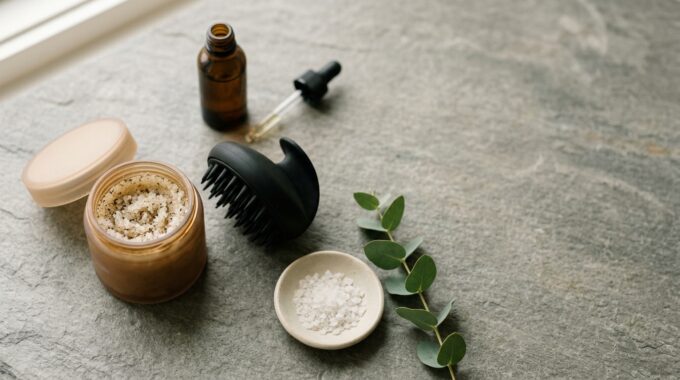
| Fine Sugar or Salt Scrub | Oily, resilient scalps | Physical lifting of dead skin and buildup | Once a week |
| Oatmeal-Based Scrub | Sensitive or easily irritated scalps | Gentle physical exfoliation with soothing properties | Every 2 weeks |
| Chemical Exfoliating Shampoo (salicylic or lactic acid) | Dandruff-prone or flaky scalps | Dissolves buildup without physical friction | Once a week |
| Light Oil Massage (jojoba, coconut) + Fingertip Massage | Dry or sensitive scalps needing gentler care | Softens debris before gentle lifting | Every 2 weeks |
For step-by-step instructions, see our DIY natural scalp scrub recipes.
Scalp Care by Hair Length
Hair length changes how exfoliation and buildup behave. Short hair or a shaved head exposes more of the scalp directly, so less product and lighter pressure generally go further. Longer hair traps more oil and sweat close to the scalp, which means dividing hair into sections during exfoliation helps make sure no area gets missed.
Adjusting for Stress and Overall Health
Scalp tension is a real, physical response to stress — tight muscles around the scalp can reduce circulation and disrupt normal oil distribution, and many men carry that tension without realizing it shows up as tightness or itching on the scalp. Slower breathing and general stress reduction won’t replace a proper exfoliation routine, but they’re a legitimate supporting factor.
Hydration and diet play a similar supporting role. Low water intake tends to leave skin — including scalp skin — drier and less resilient, while a generally poor diet can slow how quickly skin recovers after any kind of exfoliation or irritation. None of this substitutes for the physical routine, but it does affect how well the routine works.
Adjusting the Routine Seasonally
Cold weather tends to dry out the scalp, while heat and humidity tend to increase oil production — which means a fixed, year-round exfoliation schedule often doesn’t serve every season equally well.
Easing off frequency in dry winter months and allowing more recovery time, while leaning slightly more into cleansing during hot, humid months, tends to work better than rigidly sticking to one schedule regardless of season.
When Results Typically Show Up
Itching and visible flaking often decrease within the first one to two weeks of a consistent, gentle routine — one review of clinical scalp-care studies found flake and itch reduction showing up within roughly 2 to 10 weeks depending on the severity of the underlying issue.
Oil balance and hair feel at the roots tend to improve over a slightly longer stretch, often a few weeks in, and the goal throughout is consistency rather than intensity — an aggressive one-time scrub won’t get there faster than a gentle routine repeated regularly.
Recognizing Irritation vs. Normal Adjustment
A small amount of redness or mild tenderness right after exfoliating can be a normal, temporary response — but persistent redness, ongoing sensitivity, or recurring flare-ups usually mean something in the routine needs to change, whether that’s pressure, frequency, or the product being used. When irritation shows up, backing off exfoliation entirely for a week or two lets the scalp recover before trying again with a gentler approach.
Pushing through discomfort rather than adjusting the routine tends to delay recovery rather than speed up results. Listening to how the scalp actually responds matters more than sticking rigidly to any fixed schedule.
FAQ
Q1:How often should men exfoliate their scalp at home?
Oily scalps generally tolerate exfoliating once or twice a week, while dry or sensitive scalps typically do better every two weeks or less. Some dermatologists frame it as once every 7 to 10 washes rather than a fixed weekly schedule.
Q2: Does scalp exfoliation actually help hair grow?
Exfoliation doesn’t force hair to grow, but it clears buildup that can block follicles and interfere with nutrient absorption, which supports healthier growth from follicles that are already active. It won’t override genetics or a diagnosed hair-loss condition on its own.
Q3: What’s the safest way to exfoliate a sensitive scalp?
Use gentle, circular fingertip motion rather than scrubbing tools or fingernails, and stick to a lower frequency like once every two weeks. Testing a new product on a small area first and rinsing with lukewarm rather than hot water reduces the risk of irritation.
Q4: What natural ingredients work for scalp exfoliation?
Fine sugar, salt, and oatmeal are common physical exfoliants, while light oils like jojoba, coconut, or argan help soften debris beforehand. Chemical exfoliants containing salicylic or lactic acid are another option, particularly for dandruff-prone scalps.
Q5: When should a scalp problem be checked by a dermatologist?
See a doctor if there’s redness, bleeding, bumps, persistent pain, or heavy dandruff that hasn’t improved after 6 to 8 weeks of a consistent, gentle exfoliation routine. A dermatologist can rule out conditions like seborrheic dermatitis or psoriasis that look similar to ordinary buildup but need targeted treatment.
The Bottom Line
Scalp exfoliation isn’t a dramatic fix — it’s a quiet, consistent habit that clears the buildup daily shampooing misses, and the men who see real improvement are usually the ones who keep pressure light and stay consistent rather than scrubbing hard and hoping for faster results.
Match the frequency to your scalp type, pair it with simple daily habits like rinsing sweat promptly and keeping styling light, and give it a few weeks before judging whether it’s working.