
Stress Relief Routines After Long Days
Modern life rarely pauses. Due dates, family matters, unstopping alerts, and stress in the inside slowly ruin mind and body. Stress Relief Routines After Long Days are not indulgent habits — they are necessary recovery systems for people who spend most of their day in high-alert mode.
Table Of Content
- Stress Relief Routines After Long Days
- What Happens to Your Body After a Long Stressful Day
- Why End-of-Day Stress Relief Is Different from Morning Self-Care
- Principles of an Effective Stress Relief Routine
- Keep It Simple and Repeatable
- Balance Physical and Mental Release
- Consistency Over Intensity
- A 10–30 Minute Evening Reset Structure
- Transition From Work to Personal Time
- Release Physical Tension
- Unload Mental Noise
- Choose Calm Input
- Stress Relief Routines at Home
- Stress Relief Based on Energy Levels
- When You Are Physically Exhausted
- When You Are Mentally Drained but Physically Alert
- When You Are Emotionally Overwhelmed
- Bedtime Stress Relief for Better Sleep
- Stress Relief for Busy Schedules
- What Not to Do After a Stressful Day
- Long-Term Benefits of Stress Relief Routines
- How Long It Takes to Notice Change
- Creating Your Personal Stress Relief Routine
- When Stress Relief Routines Are Not Enough
- Final Thoughts
- Frequently Asked Questions
- Q1: How long should a stress relief routine be?
- Q2: Is it okay to skip days?
- Q3: Can stress relief improve sleep?
- Q4: Why does relaxation sometimes feel uncomfortable?
- Q5: Can routines reduce anxiety long term?
Normal daily stress is distinctly different and chronic stress. The stress increases and decreases with certain events day by day. In the background, there is chronic stress. You remain on high alert in terms of your nervous system even after the meeting is over or when the emails are no longer sent.
This long-term activation is observed over time to impact on sleep, stability of moods, digestion, skin and emotional strength. This is not solved by motivation. At evening, strength of resolution is exhausted. Intentional routines are also more important than inspiration since they slow down the process of decision-making and provide the signals of safety that can be expected by the body.
What Happens to Your Body After a Long Stressful Day
At the end of a tiring day, your nervous system is still in a rather alert condition. The sympathetic response, or what is commonly referred to as fight or flight is activated by the body. The heart rate escalates, muscles contract and stress hormones like cortisol elevate.
Short bursts of pressure are assisted by cortisol. However, when it is kept high in the evening, it disrupts the deep sleep, emotional control, and physical rest. That is why a great number of people are tired but can not rest. In the long run, stress disorders cause exhaustion of the nervous system due to disregard of warning signs.
Burnout does not have a sudden emergence. It is developed by accruing tension. Symptoms of your body in need of rest and not productivity encompass continued muscle spasms, insomnia, wakefulness, more irritable, and wired but weary. These are not character vices. They are biological signals that demand a healing.
Why End-of-Day Stress Relief Is Different from Morning Self-Care
Routines in the morning are concerned with activation and energy. Evening rituals are oriented towards deactivation and security. Night stress is accruing. It recounts all the events of the day. Since people experience decision fatigue at night, complicated self-improvement plans are doomed to fail.
Simplicity is the best stress management technique during the night. Habits that have low effort and high impact are effective. Soft breathing, low light and repetitive patterns assist the brain to change its performance mode into the recovery mode.
The way you close your evening is a determinant of the manner in which you will rise in the following day. When the nervous system is safe before bedtime the quality of sleep becomes better.
Principles of an Effective Stress Relief Routine
Keep It Simple and Repeatable
Complex workouts cause resistance. A brief and regular relaxation program instills confidence in your nervous system.
Balance Physical and Mental Release
Stress exists in the body and the mind. When one of the dimensions is released, the other becomes activated. Moving softly combined with relaxing the mind brings about equilibrium.
Consistency Over Intensity
Ten minutes per day will be more effective than an hour per week. Repetition is responsive to nervous systems.
A 10–30 Minute Evening Reset Structure
You do not need a long ritual. A planned but loose order is the best.
Transition From Work to Personal Time
Your mind requires a clear indication that the working day is over. Switching the clothes, clean your face, or a two minutes sit may be a psychological boundary. Stress is transferred to your home life without transitioning.
Release Physical Tension
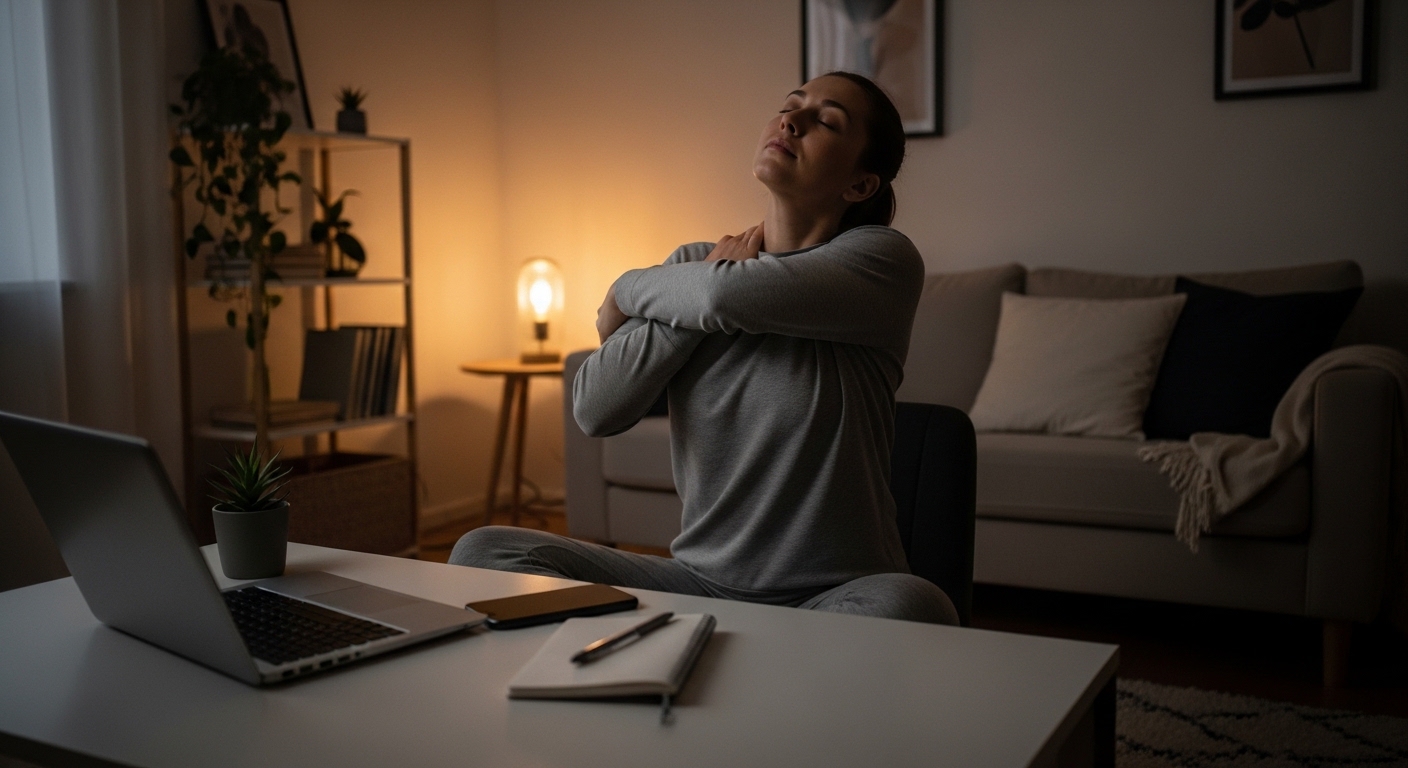
The stress usually builds up in the shoulders, jaw, hips and neck. Light and slow stretching with breathing will indicate safety. Exhalations which are slow stimulate the parasympathetic nervous system. Vigorous exercise in the late night may even make one alert instead of relaxing. Softening controlled movement is more effective in decompression.
Unload Mental Noise
Evenings can be mentally noisy due to the reduction of distractions. Cognitive pressure is relieved by writing down incomplete tasks or speaking into a voice memo. It is not to reflect profoundly. It is mental release.
Choose Calm Input
Emotional regulation is ensured in low-stimulation environments. The slowing of the brain can be done through soft music, warm lighting or silence. Continuous scrolling, however, makes over stimulation and comparison escalate, which may cause anxiety rather than alleviating it.
Stress Relief Routines at Home
Home must be a restive place, and it is frequently another stimulating environment. In the case of individuals that have families, five minutes of deliberate loneliness prior to getting into a conversation may stop emotional spillover of the working day.
In the case of someone living on their own, it is a good idea to establish a regular corner of wind-down to make the evening ground. The particular chair, lamp or blanket may be used as a psychological trigger to relaxation. The introverts tend to require silent relaxation.
Before relaxing, extroverts can enjoy a short, positive socialization. No equipment is necessary. Taking a shower, attentive tea making, or slow breathing in low-light conditions can be made into practices that are conducive to recovery.
Stress Relief Based on Energy Levels
When You Are Physically Exhausted
Restorative actions are all that should be prioritized. Physical recovery is facilitated by gentle breathing, lying with raised legs or taking warm bath. Stimulation of the media or exercise should be avoided.
When You Are Mentally Drained but Physically Alert
Mental exhaustion can be rejuvenated with light physical exercise. A slowness or a mild flow of yoga moves transpose the mind energy within the body.
When You Are Emotionally Overwhelmed
The techniques of grounding assist in controlling the strong feelings. Describing the objects in the surrounding, paying attention to slow breathing, or holding an object that is cold may bring one to be present in the moment. Healthy stress management entails emotional release and is not suppressed.
Bedtime Stress Relief for Better Sleep
Stress has a direct concern on sleep since it maintains cortisol. Your body should not be exposed to danger to be ready to rest. Candle light one hour before bed time is an indicator of change. Higher cognitive arousal is reduced with the help of elimination of high-intensity digital stimulation.
Complete screen restrictions are not realistic, but rather select low-stimulation material. Association is developed by pre-sleep rituals. When the process is repeated, the brain associates certain behaviors with rest.
This is the way that evening routines of wind-down gradually re-condition the nervous system. It is not by coercion that sleep quality can be enhanced but through subtle signalling.
Stress Relief for Busy Schedules
Not all people have 30 consecutive free time in the evening. There are schedule delays at work, children have to be taken care of and more messages are being received and the roles are mixed. In reality, most people need Stress Relief Routines After Long Days that fit into full calendars — not ideal ones.
Stress can still be controlled using micro-habits. Frequency and not duration are more important to the nervous system. Even a couple of slowness and lengthened breaths between meetings can reduce heart rate. The process of breaking the stress cycle can be achieved by taking a conscious stroll between the parking lot and the office.
Taking two minutes and leaning against a window will cause a change in your physiology. Caregivers and parents are the ones who are usually least flexible. Rather than introducing new activities, integrate relaxation methods to the current activities. When taking a shower, concentrate on warm water and taking a slow breath.
When making meals, you need to move slowly. When bedtime comes, you bring a child to sleep, turn a little of the light off, and speak in soft tones, your body is going to relax too. There are little deliberate pauses. They serve as little re-sets in the nervous system of the day. One can lower the level of cortisol and mental tension even after five minutes of conscious relaxation. When it comes to stress, it is not the length that counts but the consistency.
What Not to Do After a Stressful Day
One of the most frequent ones is doom scrolling. The brain is in a state of alarm due to endless news feeds and social media. The nervous system is energized, whereas the mind is distracted. This prevents true recovery. Alcohol is frequently employed as a fast de-compressant.
Although it has the effect of relaxing muscles, it interferes with sleep cycles, and it makes the next day more anxious. What can be experienced as relief at night, may enhance exhaustion and annoyance later. Working late into the night erases the psychological boundaries.
The brain is never given any safety signal since it does not have a defined expiry point. In the long run, this trend strengthens chronic activation. Disregard of body language is possibly the worst habit. The headaches, tense muscles, digestive pain and emotional numbness are not trifles to go through.
They are signs of accumulated stress. To manage stress, one needs awareness. These pitfalls should be avoided and so should jeopardize the gains that your daily routine is making.
Long-Term Benefits of Stress Relief Routines
Consistent Stress Relief Routines After Long Days influence far more than mood. The quality of sleep enhances due to a rise of regular cortisol levels. The stability of the digestive process is achieved since the body is more in rest and digest position.
The skin transparency can also get better due to the reduction of inflammation. Even immune capacity becomes strong when chronic stress reduces. Resilience is developed over time emotionally. You will find that minor inconveniences will no longer be too big.
The responses become quantitative and not emotional. Forbearance grows without any coercion. Minor everyday behavior accumulates into significant physiological transformation. The nervous system comes to the realization that evenings are reliable and safe. This retraining lessens the pre-training anxiety and promotes sustained recovery. The advantages are not dramatic but strong. You do not feel dramatic changes, rather you feel stability.
How Long It Takes to Notice Change
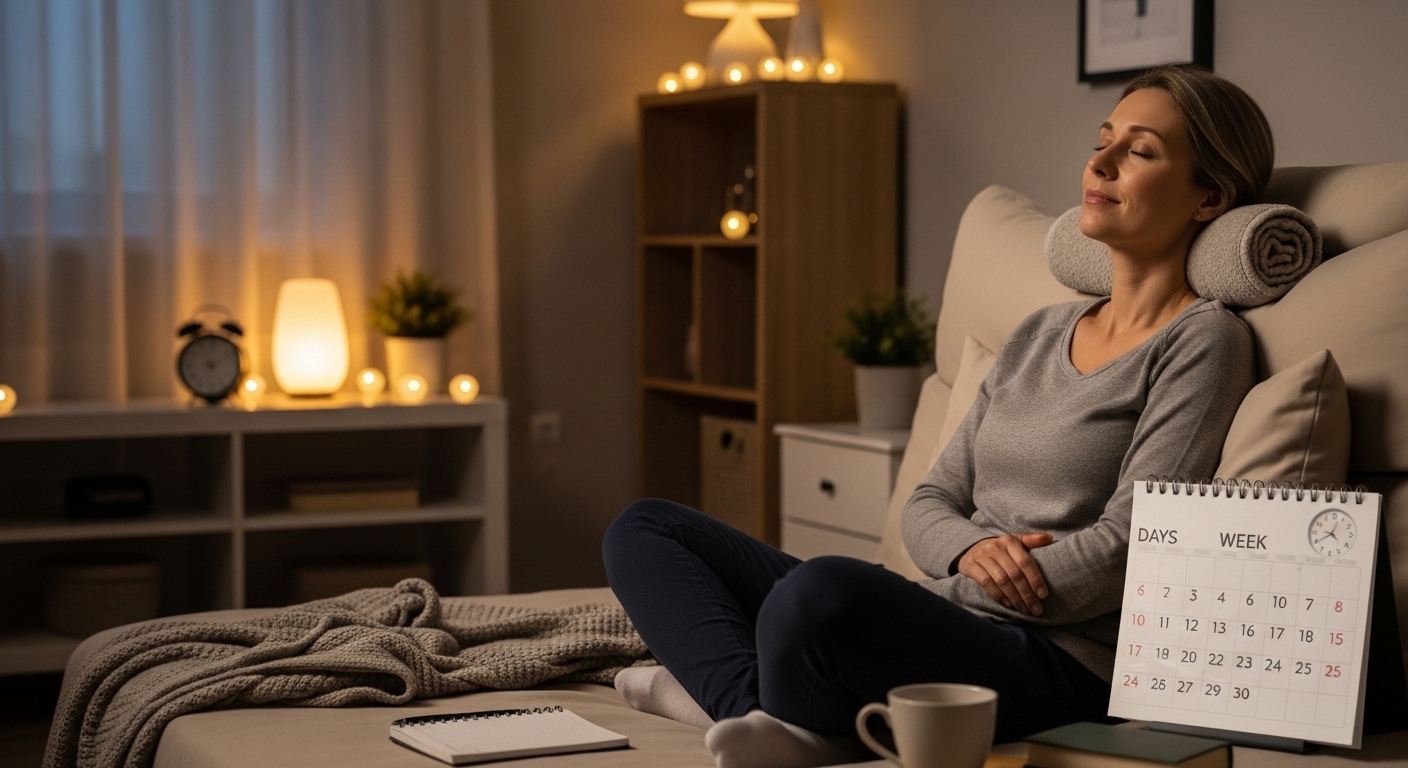
Duration of Notice to Change. Change begins quietly. During the initial days, you can just be a little calmer in the evening. Sleep may become more profound by a slight percentage. Muscles may feel less tight. Emotional regulation is likely to increase after two weeks.
You need not be in a hurry to react. Overthinking in the night can be decreased. The body starts to believe the regimen of your relaxation process. Habits become more automatic after one month. The brain prepares to the evening decompression and the transition to rest becomes more smooth.
Stress occurs, however, recovery is quicker. Outcomes are never dramatic and immediate. They are consistent and normalizing. It is not always that overwhelming, and it is the best indication of progress.
Creating Your Personal Stress Relief Routine
It makes your system sustainable as it is designed by yourself. Select two or three of the main habits. As one of the physical release techniques, gentle stretching. Writing down thoughts as they came to mind is one of the mental unloading practices. Dim lighting or silent breathing is one of the soothing rituals. Adjust the routine and make it to suit your personality.
In case you do not like meditation, do not push. Add low instrumental music in case you are a music lover. When you require organization, have a regular time. In case you would rather be flexible, follow your routine by using a habit that you already have, such as brushing your teeth.
Adjust seasonally if needed. Energy changes in the course of the year. It is possible to change your practice without losing it. It does not take consistency to mean perfection. A day off does not reverse the progress. Not strict discipline but repetition over time is the way that stress management works.
The goal of Stress Relief Routines After Long Days is not flawless execution. It is sustainable recovery that fits the real life.
When Stress Relief Routines Are Not Enough
At times tiredness does not end regardless of the effort. In case emotional numbness, chronic anxiety, irritability, and hopelessness persist over weeks, then chronic stress can exist. Emotional burnout is not similar to normal fatigue. It is usually characterised by withdrawal, lack of motivation, and lack of a sense of connection to previously important things.
When the symptoms seem to be unstopping or getting worse, professional assistance can be required. Tools other than self-directed routines can be offered by therapy, medical advice or stress counseling. Seeking help is not weakness. It is responsible self-care.
Stress relievers are effective, and they cannot take the place of professional treatment in case of a severe intervention. Resilience is the ability to know when to seek a hand.
Final Thoughts
The evening recovery is not debauchery, but labor. You do not require an ideal routine in order to feel better. Light consistency alters the patterns of the nervous system slowly. When you are weary and overburdened or emotionally drained, then start small. One relaxing event that you repeat every day can also transform your body to respond to pressure. Stress Relief Routines After Long Days are less about doing more and more about doing less — intentionally.
Frequently Asked Questions
Q1: How long should a stress relief routine be?
Ten to twenty minutes is often sufficient. Consistency matters more than duration.
Q2: Is it okay to skip days?
Yes. Flexibility prevents additional pressure. Return gently the next day.
Q3: Can stress relief improve sleep?
Yes. Lower cortisol and nervous system regulation improve sleep quality over time.
Q4: Why does relaxation sometimes feel uncomfortable?
When the body is used to constant stimulation, slowing down can initially feel unfamiliar. This sensation decreases with repetition.
Q5: Can routines reduce anxiety long term?
Consistent stress management habits strengthen emotional regulation and reduce baseline anxiety over time.