
Relaxing Evening Self-Care Rituals
Relaxing Evening Self-Care Rituals are not about adding more tasks to your already long day. They involve taking the time to close the chapter on all that you have carried in your life as far as work pressures, emotional baggage, mental clutter etc are concerned and giving them some room before sleep.
Table Of Content
- Relaxing Evening Self-Care Rituals
- Key Takeaways
- Why Evenings Matter More Than We Realize
- What Relaxation Really Means in the Evening
- How Stress Builds Up During the Day
- The Power of Ritual Over Random Self-Care
- Core Principles of Relaxing Evening Self-Care
- A 30–60 Minute Relaxing Evening Self-Care Ritual
- Step 1: Transition Out of the Day
- Step 2: Physical Unwinding
- Step 3: Mental Decompression
- Step 4: Emotional Comfort
- Short Evening Self-Care Rituals for Busy Days
- Relaxing Evening Self-Care Rituals at Home
- Adapting Evening Self-Care to Your Energy Level
- Evening Self-Care That Supports Better Sleep
- Evening Self-Care for Different Lifestyles
- What to Avoid in the Evening
- Long-Term Benefits of Relaxing Evening Self-Care Rituals
- Creating Your Personal Evening Ritual
- Choose What Genuinely Supports You
- Let Your Ritual Evolve With Your Life
- How Long It Takes to Feel Results
- Common Mistakes with Evening Self-Care
- Final Thoughts
- Frequently Asked Questions
- Q1: What are relaxing evening self-care rituals?
- Q2: How long should an evening self-care ritual be?
- Q3: Can evening self-care rituals improve sleep?
- Q4: What if I don’t have time for evening self-care?
- Q5: Is it okay to skip evening self-care some days?
In the 24/7 world, evenings may have been lost in scrolling, overthinking or unfinished tasks. Practicing Relaxing Evening Self-Care Rituals helps you slow down, reset your nervous system, and prepare your mind and body for real rest. This manual is a long one, meant to be practical, reassuring and realistic.
You will not see too much routine and stress to do everything. Rather, you will know how to construct simple and repeatable evening routines, which help to create emotional balance, sleep easier and longer, and overall well-being, at home.
Key Takeaways
- Relaxing evening self-care rituals help the nervous system shift from stress to rest.
- Relaxing nights enhance the quality of sleep, emotional stability, and vitality on the following day.
- Short and repeatable rituals are better than lengthy and ideal routines.
- Few minutes of active self-custodianship can make a difference even 5-10 minutes.
- Evening care also must not be like an additional burden.
Why Evenings Matter More Than We Realize
The vast majority of human beings believe that stress occurs during the day and gets fixed at night. As a matter of fact, the evening lies in the middle between the two. When your evenings are hectic, hyper-stimulated, or emotionally-loaded, you do not completely switch to rest mode even though you may get to sleep at the right time.
Evening self-care has nothing to do with productivity or improvement. It’s about transition. The nervous system must have a definite signal that the day is finished and it is time to relax. In the absence of this signal, the stress hormones remain high, the thoughts are continued to race and sleep becomes shallow or delayed.
That is why the evening routines tend to be more powerful than the morning ones. They do not only influence your sleep, but your level of rest the following day.
What Relaxation Really Means in the Evening
An evening of relaxing does not imply not doing anything or it does not imply being distracted until you get too tired. Most of the common evening activities, which include endless scrolling, binge-watching, or late-night work are soothing at the beginning but as a matter of fact overstimulating the brain.
The real evening relaxation can be achieved by:
- Reducing the stimulation of the mind.
- Releasing physical tension
- Creating emotional safety
- Allowing the nervous system to change to a resting state.
When this occurs, then your body is able to start repairing itself. The hormones balance, the muscles relax and your mind is clearer. That is the key to successful evening self-care in the house.
How Stress Builds Up During the Day
The stress does not wane with the termination of work. It piles within the body and mind. Shoulders get tighter, jaws tight, thoughts keep on repeating, and feelings are not processed. Many are too tired to work, but too much wired in the evening, and cannot rest.
This occurs due to the fact that stress hormones such as cortisol are not well wound down. Relaxing evening self-care rituals work by gently releasing this buildup. They do not put forth a calm, they welcome it.
The Power of Ritual Over Random Self-Care
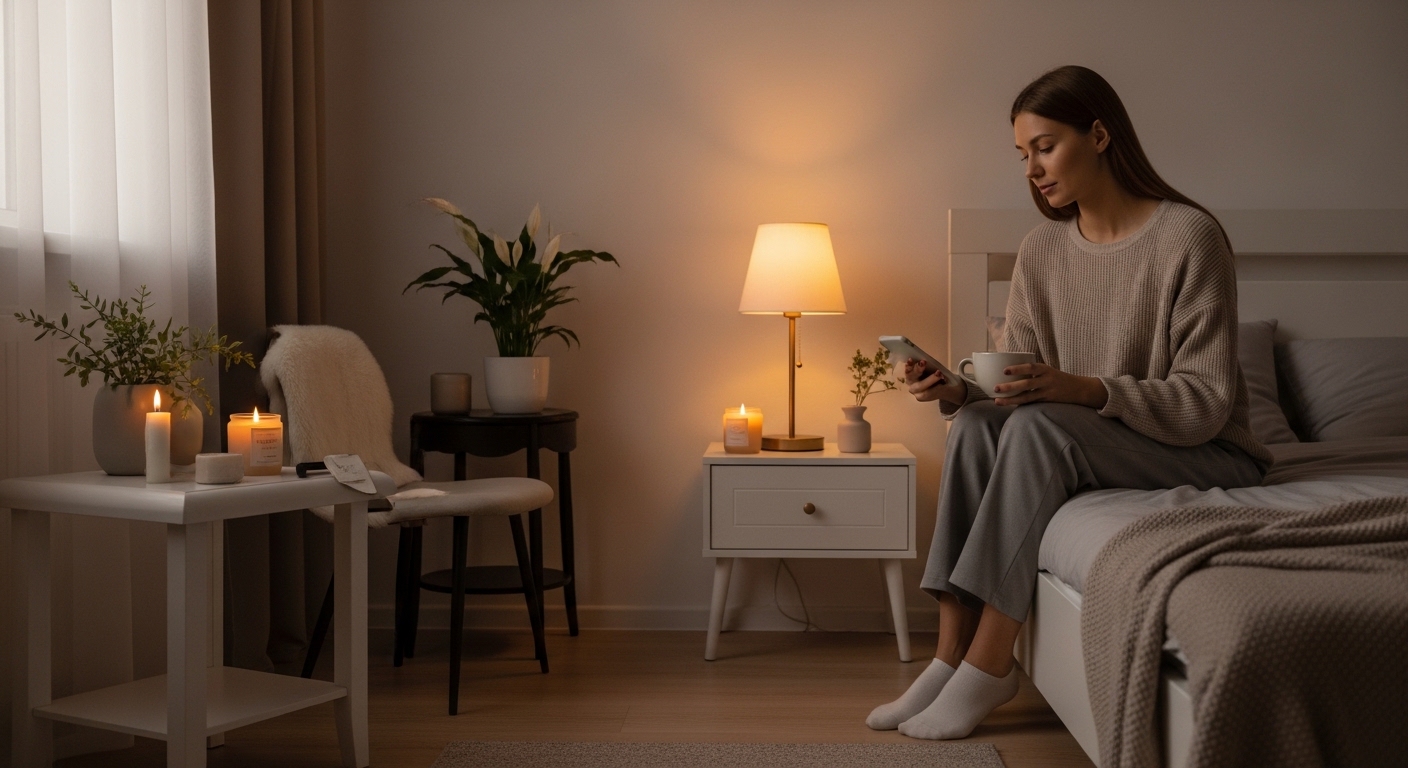
A ritual is not the same as an activity. One night, it is better to watch a show and meditate the next day, but rituals are effective as they are predictable. The more you engage in the same relaxing activities every night, the more your brain will start identifying these activities as a form of safety and relaxation.
Over time, your body learns:
This is where I released the end of the day.
This is why consistency is a better measure than length. Even the basic 10 minutes ritual performed on a regular basis is better than the elaborate one performed once a week.
Core Principles of Relaxing Evening Self-Care
These are the principles that should be kept in mind before you construct your routine:
Low effort, high comfort
Discipline should not be on evenings. Select rituals in a manner that are not stressful.
Consistency over perfection
Missing a night will not spoil progress. Light repetition is what brings change.
Comfort before correction
The evening self-care is not to fix yourself. It’s for supporting yourself.
Sensory calm
Light, soft sounds, and soft touch aid the nervous system in relaxing more rapidly than any other method of relaxation by itself.
A 30–60 Minute Relaxing Evening Self-Care Ritual
You do not need to be exact of this. Imagine that it is a structure that can be changed.
Step 1: Transition Out of the Day
The initial one is that of announcing that the day is over. This may be changing clothes, washing your face, or even just sitting and having some bit of a rest. Do not go directly to work or duties and then directly to entertainment.
This transition helps your brain switch modes and creates emotional closure.
Step 2: Physical Unwinding
The stress tends to reside in the body. Light movements, stretching, or slow breathing will aid in releasing tension that is stored in shoulders, hips and neck. It is not the moment to have intensive exercises. It is not to stimulate, but to be soft. Even some slow stretches will make your body feel held up.
Step 3: Mental Decompression
Evening is the time of loud thoughts. Rather than being problem solvers, learn to leave them to be. It can help your mind to relax by writing down the tasks or worries you still have to do tomorrow. This action helps in relaxing the mind when one is asleep and avoids thinking in bed.
Step 4: Emotional Comfort
It is in this regard that evening self-care is so nourishing. There are comfort rituals (warm showers, soft blankets, relaxing scents) which make a person feel safe. Physical rest is not any more important than emotional rest.
Short Evening Self-Care Rituals for Busy Days
It is not every evening that one has time to take a lengthy routine. Even 10 minutes can be of assistance during the hectic or tiring day.
Simple ideas include:
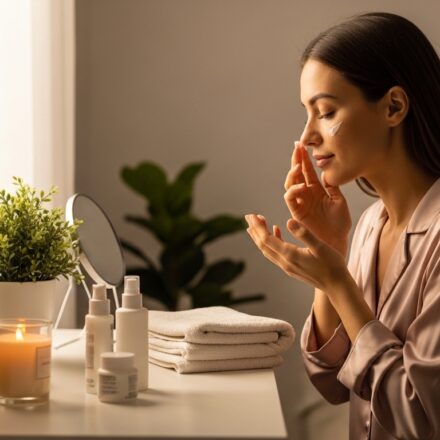
- Taking your time to cleanse your face.
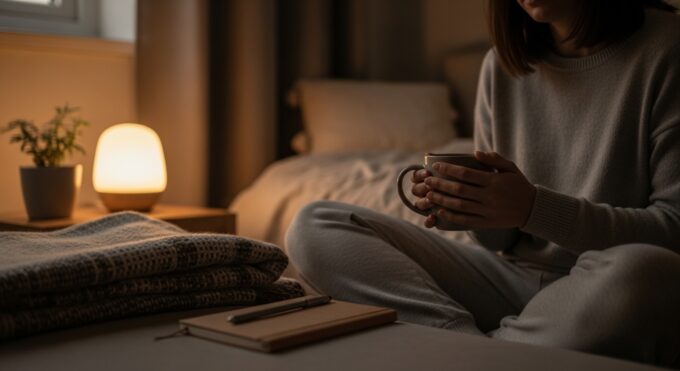
- Seated peacefully with a hot drink.
- Light breathing in the lying position.
- Using body lotion purposely.
Even now these micro-rituals can be of help in the evening when you really need to relax, and to remind your body that it is not bad to slow down.
Relaxing Evening Self-Care Rituals at Home
The good thing about evening self-care is that there is no place to go and no expenditure. Home rituals can be the most successful since these rituals are simple to repeat. Examine the environment to establish a relaxing environment by turning down the lights, decreasing the amount of noise, and selecting comfort over style. Evening relaxation is a religion of simplicity.
Adapting Evening Self-Care to Your Energy Level
Other evenings you are simply tired of being physical. There are other occasions when your physical body is in great condition, but it is your mind that is too much. Your rituals must suit the way you are; not the way you think you ought to be. When you feel your body is tired, you have to relax.
When you are psychologically exhausted, think about sensory relaxation. Grounding activities are best when one feels heavy emotionally. Being able to hear your vigor is self-respect.
Evening Self-Care That Supports Better Sleep
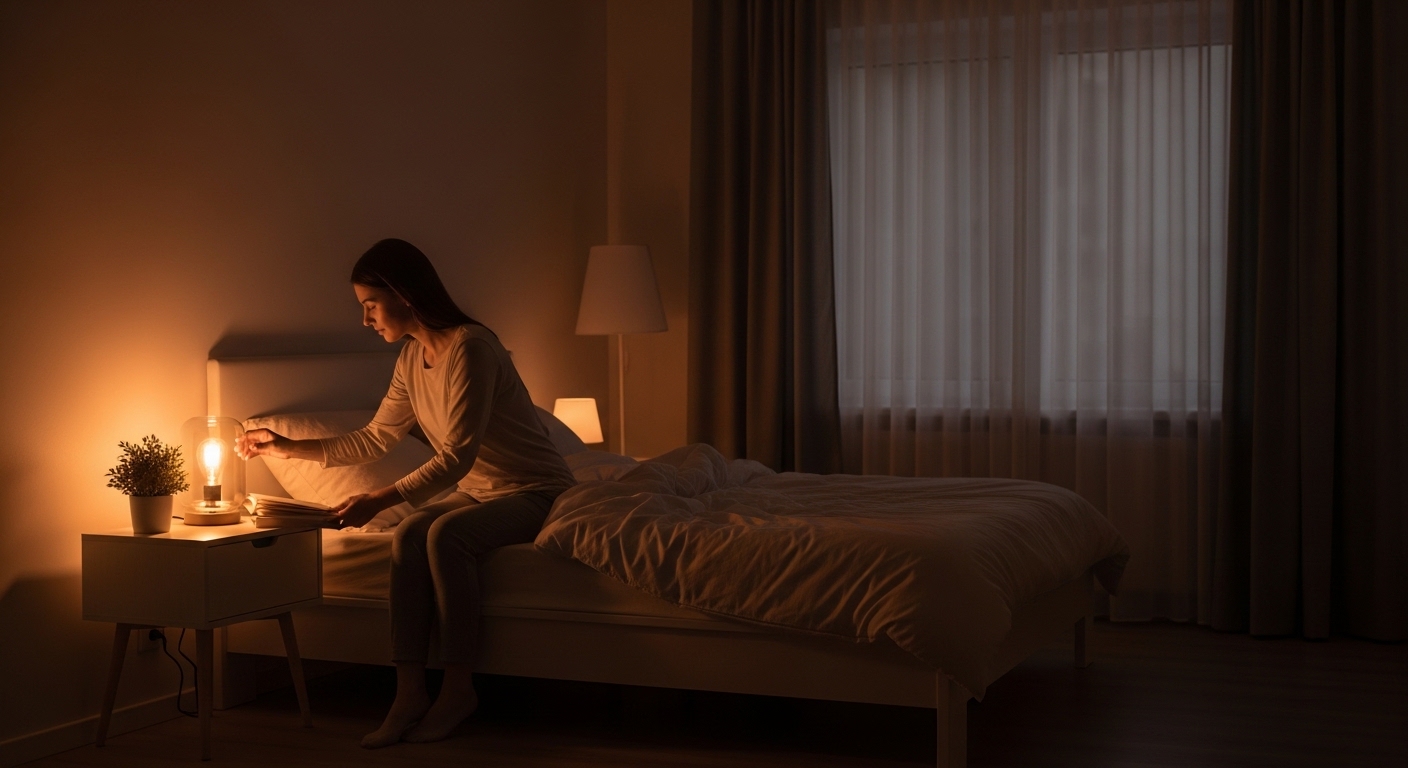
Sleep does not begin when one goes to sleep but in the evening. Relaxing evening self-care rituals help your body produce melatonin naturally by reducing stimulation and stress. This is to be avoided during bright screens, heated discussions or emotionally charged information near the time of sleep.
Rather, select the activities that are repetitive, quiet, and familiar. Having a regular bedtime will alert your brain that you are about to get some rest and thus falling asleep and keeping asleep becomes easier.
Evening Self-Care for Different Lifestyles
In the case of working professionals, the ritual practiced in the evening is useful to get out of work mode and avoid burnout.
Self-care can also occur in minute bits and bits but it still is necessary to the parents and caregivers. In case you are alone in the night, evening rituals will be able to make solitude a meal instead of the loneliness. It is not time that matters, but intentionality.
What to Avoid in the Evening
The downside of self-care is some habits obliterate the good:
- Comparison on social media or doom scrolling.
- Alcohol as a relaxation tool
- Working late and late into the night.
- Self-talk when alone is negative.
These habitual ways prevent the nervous system to relax and achieve genuine relaxation becomes more difficult.
Long-Term Benefits of Relaxing Evening Self-Care Rituals
With regular practice, evening self-care can:
- Improve sleep quality
- Lessen anxiety and emotional swamp.
- Increase daily energy
- Facilitate emotional control.
- Prevent burnout
The consequences are not very evident but significant in the long run.
Creating Your Personal Evening Ritual
Choose What Genuinely Supports You
Creating your personal evening ritual is not about copying someone else’s routine or following fixed rules. It is a conscious choice to do things that genuinely help you feel less stressed and more supported at the end of the day. The most effective rituals are simple, realistic, and aligned with your lifestyle.
Begin by choosing two or three calming actions you can repeat most nights without effort. This might include washing your face slowly, stretching for a few minutes, writing down a couple of thoughts, sipping a warm drink, or sitting quietly and focusing on your breath. These actions don’t need to be impressive or time-consuming. Their purpose is to gently signal to your mind and body that the day is coming to an end.
Let Your Ritual Evolve With Your Life
Your evening ritual should be flexible and allowed to change with your circumstances. During busy or emotionally demanding periods, your routine may naturally become shorter and softer—perhaps just a few deep breaths and an early bedtime. In calmer seasons, you may enjoy a more structured routine that includes reading, skincare, or meditation.
There is no “right” version of an evening ritual, only what feels supportive in the present moment. Above all, your routine should feel like care, not control. If it starts to feel like another task on your to-do list, it’s a sign to simplify. Evening self-care meets you where you are. It adapts rather than demands, and when it feels comforting and flexible, you are far more likely to return to it consistently.
How Long It Takes to Feel Results
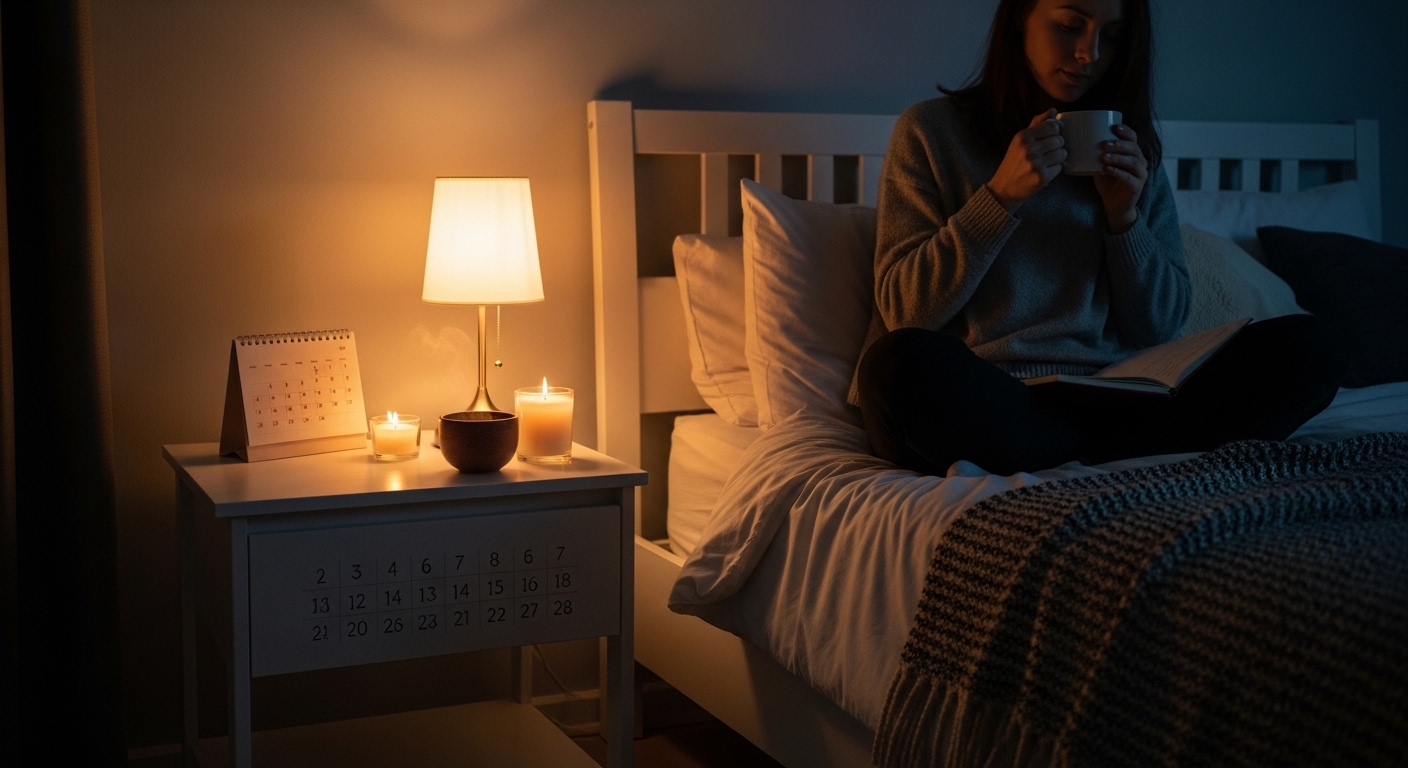
The benefit of evening self-care is that the pay-off usually starts sooner than you had thought. A good number of individuals testify to being more laid-back and rooted after a couple of evenings of deliberate evening practices. It is the satisfaction of this instantaneous relief of providing the nervous system with an unmistakable signal to relax.
Sleep changes are usually observed within a period of one to two weeks. The process of falling asleep might become less challenging, nighttime discomfort might be reduced, and mornings might become a bit less hectic or stressful. These initial gains gain momentum and achieve habit entrenchment.
The emotional resiliency, lower levels of stress, and improved mood regulation are long-term gains. These are massive transformations that are not overt. Rituals Every night eventually becomes used to your body to relax, even on the difficult days. The ritual itself requires tolerance.
In order to be significant, progress does not have to be dramatic. Individual little changes, like being able to relax a bit in the evening or being emotionally more even, are indications that your practice is taking effect. Believe in the process and leave the advantages to take their course of action.
Common Mistakes with Evening Self-Care
The biggest error with evening self-care is that it is made into a second activity that one has to get right. Rituals may also cause stress when they are too rigid or too structured to provide the benefit of relieving stress. You should not put pressure on yourself in self-care.
One more common problem is the ability to compare routines on the internet. Observation of fancy evening rituals on social media may lead to unrealistic expectation and self-judgment. Keep in mind that what acts to benefit another person might not fit in your energy or time or moods. Your ritual does not have to appear beautiful in order to work. Another pitfall is expecting immediate change.
Although the effects can be felt easily within a short period of time, long-term effects require time. When people are not getting results at the first level, they might give up on the practice. Evening self-care has nothing to do with seeking fast solutions but rather the establishment of trust with oneself.
Final Thoughts
Relaxing evening self-care rituals are not indulgent—they are essential. They assist you to unleash the day, get back in touch with yourself and get ready to enjoy a in-depth sleep. Living in a culture that values busyness, making a decision to be slow is an effective gesture of care.
You just do not have to have ideal evenings. You just need tender times of being together. In the course of time, these instances become a rhythm of their own, which helps your body, thoughts, and emotional health in the long-term aspects.
Frequently Asked Questions
Q1: What are relaxing evening self-care rituals?
Relaxing evening self-care rituals are simple, calming activities done at night to help the body and mind unwind after a long day. They support stress relief, emotional balance, and better sleep.
Q2: How long should an evening self-care ritual be?
Even 5–10 minutes is enough. The effectiveness comes from consistency, not length. Short, calming rituals done regularly work better than long routines done occasionally.
Q3: Can evening self-care rituals improve sleep?
Yes. Relaxing evening self-care rituals help lower stress hormones and prepare the nervous system for sleep, making it easier to fall asleep and stay asleep.
Q4: What if I don’t have time for evening self-care?
Even small moments count. Washing your face slowly, taking a few deep breaths, or sitting quietly for a few minutes can still provide stress relief in the evening.
Q5: Is it okay to skip evening self-care some days?
Yes. Evening self-care should never feel forced. Missing a day won’t undo progress. Gentle consistency over time is what matters most.